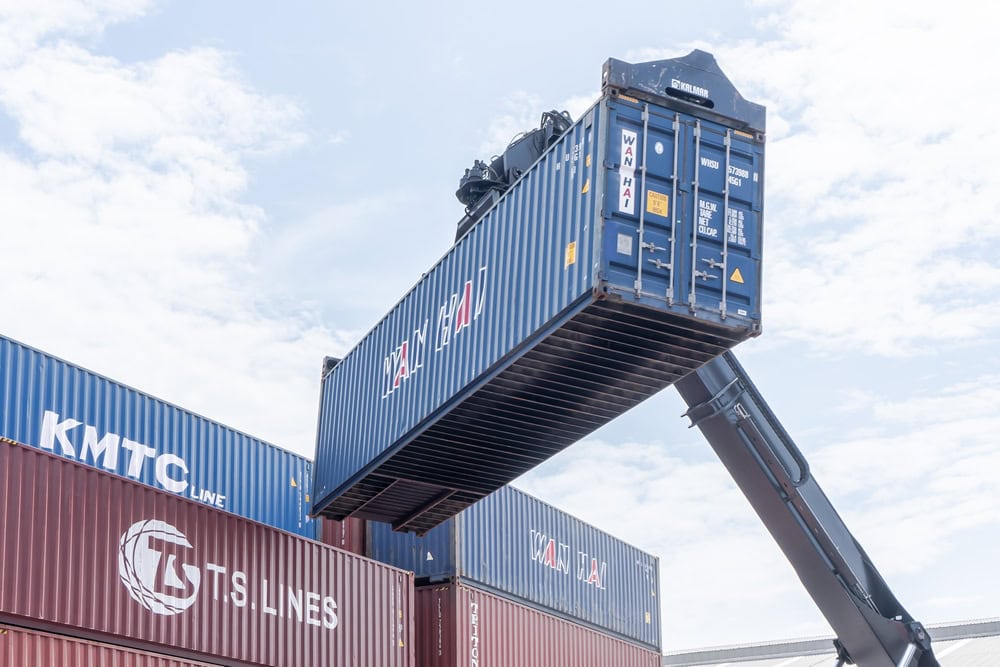
If you’re planning a delivery, sooner or later you’ll need to know how to move a shipping container safely, whether that’s straight off the lorry onto a permanent base, or repositioning one already on site. These units are built from thick corten steel to survive years at sea, which means they’re not something you can simply push into place by hand.
Weight is the first thing to get your head around. For example, an empty 20ft container typically weighs somewhere between 2.2 and 2.4 tonnes, and that figure climbs sharply once it’s loaded. Knowing this matters because it dictates almost everything else, from the equipment you’ll need to the ground you’ll need to prepare. Below, we’ll break down why containers are so tricky to shift, how to get your site ready, and the five main methods used to move a shipping container, along with the safety points worth knowing before you start.
Why Can Moving a Shipping Container Be Challenging?
The short answer is weight, and lots of it. Shipping containers are engineered to be stacked six or seven high on cargo ships and to withstand rough handling at ports, so they’re built tough. That strength is exactly why they make such reliable storage units and site offices. It’s also why moving one isn’t a two-person job.
In practice, an empty standard 20ft unit generally weighs around 2.2 to 2.4 tonnes (roughly 2,200 to 2,400kg), while a 20ft high cube container, with its extra height, tends to sit slightly heavier again. Once cargo or equipment goes inside, the gross weight can rise well beyond that, with most 20ft units rated to carry a maximum combined weight of over 20 tonnes. Even when empty, that’s still more than most vehicles, which explains why specialist equipment is non-negotiable.
Add in awkward access, sloped ground, or a tight urban site, and the challenge multiplies. This is precisely why planning ahead, rather than turning up and hoping for the best, makes such a difference to how smoothly the move goes.
Getting Your Site Ready for a Container Move
A container is only as easy to move as the site allows. Before delivery day, a few basics will save you time, money, and a fair amount of stress.
- Choose the right location. Pick a spot that’s reasonably level and, ideally, sheltered from standing water and prevailing wind. Think about how the container will be used once it’s down, since repositioning it later is far more hassle than getting it right first time.
- Prepare a solid base. Soft or uneven ground will cause a container to sink, twist, or sit unevenly over time. Concrete pads, paving slabs, or timber railway sleepers are all commonly used to create a stable, level footing.
- Check your access routes. Delivery vehicles and lifting equipment need enough clearance to reach the site safely. Measure gateways, overhead cables, and turning circles before booking a slot, not after.
Getting this right before the container arrives means the actual move, whichever method you choose, goes far more smoothly.
Container Moving Methods
Once your site is ready, it’s a question of picking the right way to move a shipping container for the job. The best choice depends on your budget, your access, and how heavy the container is once you factor in its contents.
Forklift
A forklift can lift and position a container, but only if it’s up to the job. Standard warehouse forklifts simply don’t have the capacity, so you’ll need a heavy-duty model rated for several tonnes, or in some cases, two forklifts working in tandem. This method suits flat, open sites with plenty of room to manoeuvre, and it’s worth confirming the machine’s maximum lifting capacity against the container’s weight before attempting anything.
Tilt Bed Trailer
Also known as a rollback truck, a tilt bed trailer tips its bed to a steep angle so the container can be winched on and off without any lifting at all. Chains attach to the container’s corner castings, the bed tilts, and the unit is gradually dragged into place. It’s one of the most practical ways to move a shipping container without a crane, though it does need reasonable space to manoeuvre and shouldn’t be used with a fully loaded unit.
Dolly
Given how heavy a 10ft, 20ft or 40ft shipping container is, even short moves need proper equipment. A container dolly is a low, wheeled platform designed specifically for shifting containers over short distances, such as within a yard or across a site. Dollies are compact, don’t require a specialist licence to operate, and are often fitted with locking cones that keep the container secure as it’s towed. For short hops rather than long journeys, a dolly is often the simplest option.
Toe Jack
A toe jack isn’t a complete moving solution on its own, but it plays a useful supporting role. Its thin, wedge-shaped foot slides beneath the container to lift one corner just enough to slot a dolly or skate underneath. It’s a straightforward way to raise a heavy unit safely, without straining the people doing the work.
Crane
For sheer capability, nothing beats a crane. It can lift a container clean off a lorry and set it down precisely where you need it, which makes it the go-to option for tight or restricted sites where dragging or winching isn’t practical. The trade-off is cost and licensing, since crane hire needs a qualified operator and can be one of the pricier ways to move a container. It’s often worth it, though, when precision matters more than budget.
Safety Considerations when Moving a Shipping Container
Whichever method you use to move a shipping container, safety has to come first at every stage.
- Only use lifting or towing equipment rated for the container’s full weight, including anything stored inside.
- Wherever possible, empty the container before moving it. A loaded unit shifts the centre of gravity and adds unpredictable strain.
- Secure the container properly during transport, particularly with tilt bed methods where the load is briefly at an angle.
- Leave the job to trained, experienced operators. Forklifts, cranes, and tilt bed trailers all carry real risk if handled by someone unfamiliar with the equipment.
- Keep bystanders well clear of the working area while lifting or towing is underway.
Cutting corners here isn’t worth it. A container weighing several tonnes doesn’t forgive mistakes.
Shipping Containers at KH Containers
Whether you’re weighing up storage for a construction site, a secure lock-up for equipment, or a compact site office, knowing how to move a shipping container safely puts you in a much stronger position before you buy.
At KH Containers, we supply a full range of new and used containers to suit different budgets and requirements, from compact 10ft containers for smaller storage needs, through to our popular 20ft containers and larger 40ft containers for bigger sites. We also stock high cube containers for those needing extra headroom or storage capacity.
Every unit we supply is available as either new or used, so you can choose the option that best fits your budget without compromising on quality. As a family-run business, we take pride in offering honest advice alongside every container we sell, including guidance on siting and delivery.
Not sure which size or condition suits your project? Get in touch with our team today and we’ll help you find the right container, delivered and positioned safely, first time.
Knowledge Hub
Related Past Projects and Practical Advice
Browse our blog and peruse our projects for top tips and fresh inspiration. See how we’ve helped businesses just like yours find the ideal solution.